Audio

Great Expectations

Great Expectations

A lesson I’ve learned through long – and often difficult – experience: great project management is actually great expectation management.

Over-promising and under-delivering are the ingredients for disatisfaction.

Similarly, not being transparent about the true state of work is also common among failed projects.

Setting expectations appropriately, and meeting those expectations once set, may not make every stakeholder 100% happy. But they will at least be informed, and rarely surprised.

Look – everyone knows good fences make good neighbors. Clearly spelled out project scopes are the virtual equivalents of good fences. And as I said in yesterday’s ‘cast, a solid look of success let’s everyone know what the successful conclusion of their project is, right from the start.

So:

  • Clearly articulate what will be done on a project, by whom, and by what date,
  • Clearly specify what the successful completion of the project will look like, and
  • Set – and maintain – the appropriate expectations of what can, will, and won’t be done.

Before leaving this topic, let me just add this: until the last piece of a project is completed, the care and feeding of the expectations of your stakeholders should always be at the very top of your daily to-do lists.

Because in the absence of good information, your customers will create their own narratives, where you may not be the hero.

Control the narrative. Create Great Expectations.

Go, and be you.
Audio

The Look of Success

Look of Success

You might be surprised at the number of projects that get greenlit, without a well-defined scope of work, or anything close to a definition of what a successful completion will look like.

Or, if you’ve lived through one of these nightmares, perhaps this is no surprise at all.

Any sane project manager will insist on a clear scope of work, before signing off on spending time, resources, and capital on a project. A clear and well defined look of success isn’t just nice – it’s required, before doing anything else.

The entire value proposition of a given project is totally dependent upon its look of success; because, it should be the most desired outcome of a project, by which its ultimate success – or failure – can clearly be judged.

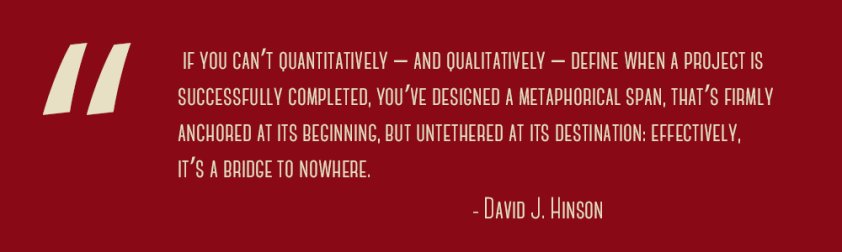
For, if you can’t quantitatively – and qualitatively – define when a project is successfully completed, you’ve designed a metaphorical span, that’s firmly anchored at its beginning, but untethered at its destination: effectively, it’s a bridge to nowhere.

Remember: all successful projects have a clearly defined finish, before they have a beginning at all.

Lacking a look of success does virtually guarantee one thing, though: the certainty of failure.

Go, and be you.

Audio

Analysis Paralysis

Analysis Paralysis

There’s covering all your bases. Considering all the options. Letting every voice be heard.

And then – there’s the death of a thousand cuts of having a project “glued in place” by Analysis Paralysis: over-analyzing (or over-thinking) a situation so that a decision or action is never taken, in effect, paralyzing the outcome.

If you’re an “Ol’ skooler”, you may have heard the same thing described as “death by committee.”

Good, effective governance is hard. What makes it hard is that when more than a handful of voices are involved in a design of any size, timeliness and opportunity can quickly be lost, in the fight for the inconsequential.

So – how does one avoid “analysis paralysis?”

Start by having only those involved with an actual stake in the governance process. If they aren’t a stakeholder, they’re off the team.

Secondly, before planning or deliberations begin, everyone will be aware of what has to be accomplished, with a “look of success” defined for what a successful, and complete, outcome will be.

And finally, you have to involve participants in your process who are actively engaged and working in good faith to move the project forward.

Sometimes, you don’t get to choose who is on the team. Or, you have to work with members who are actively throwing roadblocks in the way of progress quite intentionally.

The only real curative is to hold those team members publicly accountable, and challenge them, directly or indirectly. Otherwise, they will leach away every bit of momentum – or worse, opportunity – you need to succeed.

Go, and be you.

Moving On – Redux

Not farewell. But so long.

davidjhinson's avatarLogorrhea

I Have a Job

Monday, June 8, I start a new job, and a new chapter in the lives of my family.

I am the new Director of IT at Yeshiva of Flatbush, in Brooklyn, NY.

If I were to choose a “next step” that is as different from where I am today, as could be imagined, I would be hard pressed to do so.

Moving from the South to the North. Moving from a town of 60,000 to a city of 8.4 million (about 4 times the size of the entire state of Arkansas, my current domicile). From the Bible Belt, to the Big Apple.

Transportation. Museums. Dining. Sports. Entertainment. Culture. In many respects, it will be the equivalent to living on an entirely different planet.

Leaving Conway will, however, be extremely bittersweet. The friends and colleagues we leave behind will be missed terribly. I can say without hint of reservation that my time at…

View original post 93 more words

Audio

Transitions

Transitions

If there’s any single event, that has shaped my life, it was the fire that destroyed my childhood home.

Happily, there was no loss of human life – though, we did lose a much beloved family pet.

We were left quite literally with only the clothes on our backs.

Now, at the time, I was a sophomore at Western Kentucky University, and away at school when the fire broke out. Since the fire occurred in the morning, the only one home at the time was my mother, and she was able to safely escape; terribly shaken, but physically unhurt.

My dad called me later that evening to give me the news. I cried, for my pet. And I went home the next day.

Hearing about it over the phone was terrible. Seeing it in person was devastating.

Our house was a complete loss. The fire started in the laundry room, adjacent to my bedroom, and so everything that I had owned, made, or cherished – from earliest childhood on – was simply gone. Just – gone.

We had our lives, and nothing else.

It was more than enough.

With loving help from friends and neighbors, we were able to cram five people into a two-bedroom apartment, while our house was rebuilt within the shell of the exterior that remained.

The fire changed everything for us. It changed what we valued. It changed who we were.

And its effects are still being felt today, thirty years on, as my family still lives with the consequences of everything that happened after.

Things are things. They can always be replaced.

But people, and experiences – they are the rarest of life’s treasures.

When you find yourself wanting something more, wanting something else, or simply wanting – hold tight to those you love. Tell them it will be alright. Tell them you love them.

And it will be.

Go, and be you.

Audio

Cost versus Value

Originally appeared in Logorrhea.

I love being a programmer. There’s just something about taking an idea, and pulling together a bunch of formless elements into something cogent, useful, and – hopefully – beautiful. It’s the same process of creation that attracts me to writing – though I am a far less talented writer than I am a coder.

But even as much as I love creating software, and working with people on their ideas for applications and products, there is a side to the developer life that I find tedious, and entirely off-putting: having to continually explain cost versus value; usually, winding up on the losing side of the conversation, if only because I’ve thrown up my hands in exasperation, or maybe have just rolled my eyes as far back into my head as they would go.

When we think that paying more than $0.99 for an application is too expensive, something is wrong. When we want an enterprise-grade, responsive website, with all the bells and whistles – for $500something is wrong.

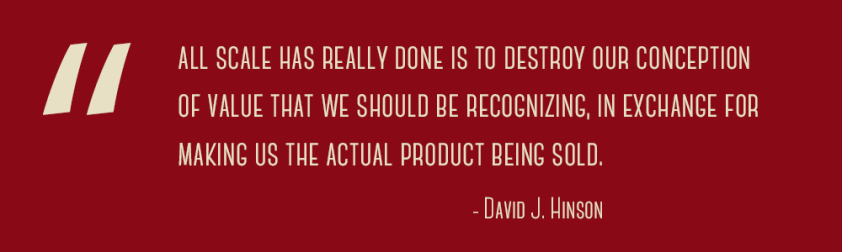
As consumers, we’ve been conditioned to conflate cost with value. I blame the Internet, and the tsunami that is the consumerization of technology. “Free” applications and services have lulled us into a false sense of frictionless commerce, believing that we now live in a time of economic magic, and scale has made everything cost nothing. In fact, all scale has really done is to destroy our conception of value that we definitely should be recognizing, in exchange for making us the actual product being sold. Amazon, Facebook, and Google: I’m looking at you.

It’s not just development that has had cost versus value turned on its head: cab rides, shopping, education, and most notably music, have been and are disrupted to the point of unrecognizability.

It’s incumbent upon us, as consumers, as citizens, and as people – to recognize that the creative process has an intrinsic value; that education has an intrinsic value; that our passions have an intrinsic value – that goes beyond a race to the bottom, where the only metric that is important is a price tag.

Where we know the cost of everything.

But the value of nothing.

Go, and be you.

Audio

Know – and Care – About Your People

Care for Your People

I’m not going to ask anyone to go out and hug a tree or adopt a puppy.

But if you truly want to develop a strong and cohesive team, and have any hope of keeping that team together, it begins and ends with understanding your people, and caring about how they are developing as people and professionals.

You don’t have to create “forced fun” departmental outings. You don’t have to hold impromptu celebrations for every life event. But, you do have to care, and show you care, through authentic actions.

Know when their parents are undergoing a health crisis. Be aware that their living situation is in transition. If you understand challenges facing your talent outside of work, it should make your workplace communications more empathetic and compassionate. There. I said it. Compassionate.

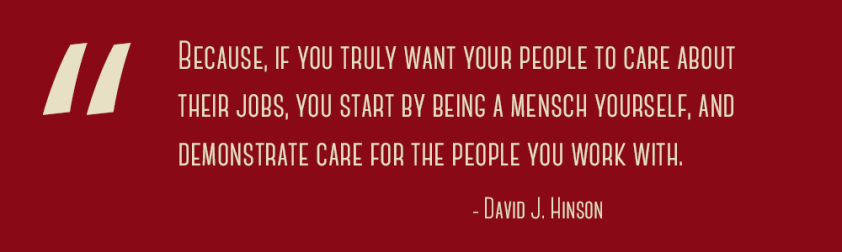
Because, if you truly want your people to care about their jobs, you start by being a mensch yourself, and demonstrate care for the people you work with.

You don’t have to be creepy, you don’t have to be intrusive – and you can still remain professional.

When you’re attuned to the needs of your team, inside and outside the workplace, you can anticipate potential disruptions and interruptions, and make much better decisions with regard to assignments.

Plus, just being a better person is reward unto itself.

Go, and be you.

Audio

The 2015 Dean’s List: EdTech’s Must-Read Higher Ed IT Blogs

Dean's List

Today, I’m going to “break format” a bit, from our regularly scheduled “daily dose of awesome.”

Why?

Well, for the second year in a row, one of my blogs was named as a Top 50 “Must-Read Higher Ed IT Blog” by EdTech for Higher Education.

Last year, my personal blog, Logorrhea, made the 2014 Dean’s List.

This year, 300 Words, 2 Minutes made the 2015 cut.

I’m pleased and honored to have our little corner of the podcast-o-sphere included in this select group of education thinkers and thought leaders.

Somehow, I slipped through the cracks and made it in. So, I guess I’ll just have hold up my end of the bargain, from now on out.

Thanks to everyone who has given me kind words of support, encouragement, and helpful feedback as I have gotten 300 Words, 2 Minutes off the ground. It’s been immensely gratifying to see something take shape from nothing, and then have it take on a life of its own.

Tomorrow, we’ll return to our regularly scheduled programming…

But for now…

Go, and be you.

Audio

Training Is Not an Option, It’s a Necessity

Training

Sad but true, training — and travel for training — are often the first things axed when the institution’s leadership comes looking for low-hanging budget savings.

But here is where you earn your pay: you have to fight to keep training alive.

Because without it, you’re simply biding time until the talent you want to keep has walked out the door. Because the talent that can, will.

Training is actually your best tool for keeping employees engaged and excited. It allows them to envision where they will be a few steps down the road, because they can see themselves becoming more valuable to their institution.

Of course, the more skills your talent acquires on the job, the easier to walk out the door for greener pastures. But training also promotes trust because it says that you value that person’s future, are interested in them as individuals with ambitions and goals, and are tangibly invested in seeing them achieve their goals.

Putting off training and travel for training for anything other than “we can’t pay the bills” is foolhardy; it virtually guarantees apathy and distrust in anything else you do to try and rally the troops.

But the most obvious benefit to a strong and dedicated commitment to training is that it is often the only avenue remaining to budget-constrained organizations to obtain new skills and master emerging technologies.

What are your strategies for professional development for your staff?

Go, and be you.

Audio

Non-Profit Technologists: What Keeps Us Up Nights

Non-profit Technologists

What Keeps You Up Nights?

This is almost a trick question, especially if you work for a non-profit and are responsible for technology in your organization – because the answer is: Everything.

Sure, there are frequently heard answers. Keeping the “trains running on time.” Keeping the “lights on.” Keeping the “main thing, the main thing.”

But – to truly be effective, and innovative – one must look beyond service level agreements, disaster recovery, and crisis planning, and ask – what are the next level challenges that I must overcome as a non-profit technologist?

Technology Refreshes: Non-profits are – and always will be – challenged with funding uncertainty, year over year. As such, planned and dependable technology refreshes – new computers, software updates, new technology purchases – will always be unpredictable and undependable IF your strategy depends only on operating budgets. Innovative non-profit technologists must be versed in grant writing, collaborating with development officers to set up recurring capitalization instruments, such as endowments and chairships. Otherwise, your technology refreshes will always compete – and lose to – higher priority funding, such as compensation and deferred maintenance. Which leads to…

Staff Compensation and Development: When funding times get tough, training and professional development are the first things to go in the operating budget. Recruiting – and keeping – top talent in non-profit organizations is well-nigh impossible. As a leader in the space, you will have to fight over every single dollar; you are not just competing with other non-profits, but anyone funding a tech position. You will have to be able to offer creative forms of compensation, that meaningfully move the needle to affect the quality of life for your staff.

Staying Ahead of the Infrastructure Curve: Large scale investments in our underlying infrastructure (networking, wireless, maintenance, access) demands the lion’s share of our technology planning, and funding. Without adequate infrastructure funding, it’s impossible to stay ahead of the demand curve. Standing pat is no longer an option in this new “Experience Economy”, when always on isn’t an amenity – it’s a necessity; the new normal.

What keeps you up nights, as a non-profit technologist?

Go, and be you.