Audio

Training Is Not an Option, It’s a Necessity

Training

Sad but true, training — and travel for training — are often the first things axed when the institution’s leadership comes looking for low-hanging budget savings.

But here is where you earn your pay: you have to fight to keep training alive.

Because without it, you’re simply biding time until the talent you want to keep has walked out the door. Because the talent that can, will.

Training is actually your best tool for keeping employees engaged and excited. It allows them to envision where they will be a few steps down the road, because they can see themselves becoming more valuable to their institution.

Of course, the more skills your talent acquires on the job, the easier to walk out the door for greener pastures. But training also promotes trust because it says that you value that person’s future, are interested in them as individuals with ambitions and goals, and are tangibly invested in seeing them achieve their goals.

Putting off training and travel for training for anything other than “we can’t pay the bills” is foolhardy; it virtually guarantees apathy and distrust in anything else you do to try and rally the troops.

But the most obvious benefit to a strong and dedicated commitment to training is that it is often the only avenue remaining to budget-constrained organizations to obtain new skills and master emerging technologies.

What are your strategies for professional development for your staff?

Go, and be you.

Audio

Non-Profit Technologists: What Keeps Us Up Nights

Non-profit Technologists

What Keeps You Up Nights?

This is almost a trick question, especially if you work for a non-profit and are responsible for technology in your organization – because the answer is: Everything.

Sure, there are frequently heard answers. Keeping the “trains running on time.” Keeping the “lights on.” Keeping the “main thing, the main thing.”

But – to truly be effective, and innovative – one must look beyond service level agreements, disaster recovery, and crisis planning, and ask – what are the next level challenges that I must overcome as a non-profit technologist?

Technology Refreshes: Non-profits are – and always will be – challenged with funding uncertainty, year over year. As such, planned and dependable technology refreshes – new computers, software updates, new technology purchases – will always be unpredictable and undependable IF your strategy depends only on operating budgets. Innovative non-profit technologists must be versed in grant writing, collaborating with development officers to set up recurring capitalization instruments, such as endowments and chairships. Otherwise, your technology refreshes will always compete – and lose to – higher priority funding, such as compensation and deferred maintenance. Which leads to…

Staff Compensation and Development: When funding times get tough, training and professional development are the first things to go in the operating budget. Recruiting – and keeping – top talent in non-profit organizations is well-nigh impossible. As a leader in the space, you will have to fight over every single dollar; you are not just competing with other non-profits, but anyone funding a tech position. You will have to be able to offer creative forms of compensation, that meaningfully move the needle to affect the quality of life for your staff.

Staying Ahead of the Infrastructure Curve: Large scale investments in our underlying infrastructure (networking, wireless, maintenance, access) demands the lion’s share of our technology planning, and funding. Without adequate infrastructure funding, it’s impossible to stay ahead of the demand curve. Standing pat is no longer an option in this new “Experience Economy”, when always on isn’t an amenity – it’s a necessity; the new normal.

What keeps you up nights, as a non-profit technologist?

Go, and be you.

Audio

What’s Your Content Strategy?

Content Creation

Back in the day, you were probably laser-focused on your blog’s subscriber counts, and the number of daily visitors to your site.

Today – perhaps not so much.

I mean – sure, it is nice to have high site traffic, and lots of eyeballs. Always has been, always will be.

But the way content is consumed today, is radically different than the way it was consumed, just a few short years ago. Today, individual “greatest hit” posts drive repeat traffic to your sites, as opposed to “loyal readers” who visit daily to catch the pearls of wisdom that have dropped from your keyboard.

For the last two years, well over 50% of the daily traffic on my personal blog comes from just a handful of popular posts. New content does make up a portion of the spike in my site’s daily traffic; but these spikes are usually very short lived, and it is really the “hit” posts that keep our recurring traffic numbers consistently high, week-after-week.

As content curation platforms, Facebook and Twitter have driven this change in consumer behaviour. We’re now conditioned to share our audio, photos, videos, and articles in easily digestible chunks of time and attention span.

And as a content creator, you now have to carefully consider not only the raw material you’re creating, but the many forms and channels it will be repurposed into. You need to think about how your content is actually part of a mosaic of information, rather than a tightly-woven tapestry; a mixtape, rather than an album.

Focus on superior content, to be sure. But design it to be repackaged, repurposed, and evergreen – from the very beginning of your creative process.

What are your strategies for creating content that has a shelf-life beyond the morning’s cup of coffee?

Go, and be you.

Audio

Musical Interludes

Musical Interludes

My favorite “downtime” activity is playing music.

It allows me to exercise my mind creatively, while allowing me to forget – for a while, at least – the cares of the day in an activity that inspires and restores me.

Of all the developers with whom I’ve worked over the years, far and away the most talented and creative were also musicians.

In part, I think this has to do with the fact that many of the skills needed by great developers (and entrepreneurs, for that matter) overlap. Great musicians need to be disciplined, self-directed, and have a knack for collaboration. They need to be able to communicate with their creative partners on an intuitive, almost visceral level. And they need to be able to improvise, and play on the fly, within a fluid structural framework.

Truly great musicians inspire, create, and innovate. Truly great entrepreneurs and developers do exactly the same.

And – though there are many musicians and developers, who through long practice and dedicated effort, have made themselves into technically superior maestros, there are a rarer few who have a genius that no amount of practice or will can ever hope to attain.

Sadly, I am no musical, nor developer, genius. But it doesn’t mean that I don’t recognize, and appreciate it, when I see and hear it. It inspires me to be better, and hopefully in my turn, inspire someone else to be better.

What do you do, to stretch your creative muscles?

Go, and be you.

Audio

When the Only News is Bad News

Bad News

Bad news is hard to give, and even harder to receive.

When you’re communicating bad news, you might try and soften the blow, to deflect some of the pain you know the receiver will experience. Let’s face it – rarely do these attempts to “ease into” troubling news ever work the way we intended.

Bad news is notoriously given just before an extended break away from work – before a holiday, before summer break, or on a Friday afternoon – again, with the idea that the severity of the news can be managed, its scope hidden or simply buried.

Likewise, conflating the telling of bad news with good (or at least, marginally, better) news, in the hopes it will limit damages, really only fools ourselves.

Receiving bad news is an entirely passive experience – which makes it so much worse, not better. Feeling helpless in the face of bad news adds exponentially to the misery of its reception.

Try to do the following, when you’re the harbinger of ill tidings:

  • Communicate bad news to the people it affects as early as you ethically and possibly can. Nothing is worse than finding out bad news, from someone other than the person who should be telling you, first.
  • Be accurate and honest in relating bad news. There’s no sense in sugar-coating anything; the truth will eventually come out. So, tell it like it is.
  • Don’t count on events outpacing bad news, and somehow solving the problem of relating bad news for you.

No one wants to be the bearer of – or worse – the cause of bad news. But that doesn’t excuse you from being accountable, responsible, or ethical.

How you convey bad news is a true test of your mettle as a leader, and your dependability in a crisis. Don’t shirk your responsibility when adversity inevitably arrives – step up, and show why they gave you the job in the first place.

Go, and be you.

Audio

Customer Experience

Customer Experience

From a talk given in 2014, on Customer Experience.

Customer Experience is a major filter I use in my decision making process, in order to justify new acquisitions.

If I’m looking at new software, if I’m looking at new hardware, if I’m looking to make a new hire, I always pass those [decisions] through the filter of customer experience.

Ultimately, if I can’t succinctly and forcefully describe how those [new] acquisitions will positively impact customer experience, then I have failed; and that’s a huge [stop] sign that tells me I need to stop and reconsider.

Conversely, if not making those new acquisitions, if not making those new hires… if that will have a significant negative effect, that’s also important in my decision making process; not only for describing to my constituents why I’m making particular decisions, but also [in order] to frame my story to my colleagues, and more importantly, to my President, [in order] to say “this is where this decision fits within our larger strategic initiatives.”

Because, you’re always dealing with competing forces within your organization.

If I can show the value made to student experience, to faculty experience, to staff experience, I stand a much better chance at being funded, and supported, and ultimately, sustained over the long haul.

Go, and be you.

Audio

Forging Leadership

Forging Leadership

Are leaders made, or born?

The answer is: Yes.

Truthfully, some people are born to lead. They are seemingly gifted with all the charisma, comeliness, talent, wisdom one can possible have – everything they need to inspire others to follow them to the ends of the earth. Right out of the box.

And – some leaders are definitely made, driven into leadership through necessity, experience, and sheer force of will.

We don’t choose the forge that tempers our fates. If that were so, I daresay that most of us would have chosen another path, other than the one that ultimately sets us on our life’s journey.

But that’s not to imply that all leadership development is by chance, entirely by accident.

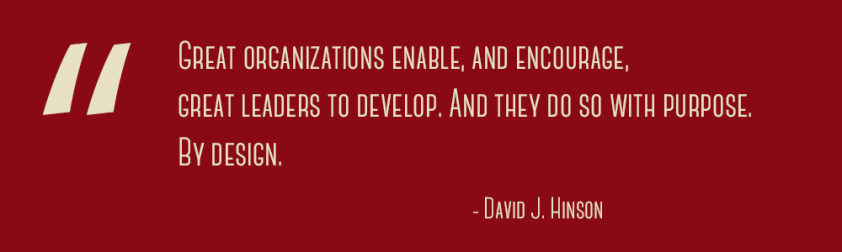
Great organizations enable, and encourage, great leaders to develop. And they do so with purpose. By design.

So – How does one go about building a healthy environment for leadership development?

It starts by hiring the right people. And by the right people, I don’t simply mean only people that could lead teams tomorrow. Hiring the right people includes perceiving individuals, who seem to lack overtly obvious leadership traits, but are “diamonds in the rough.” We are talking about “leadership development”, after all.

You also need demographically and experientially diverse teams to inculcate leadership skills; people that know the ropes – inside and out – of your organization, and are unselfishly willing to mentor their charges. Diversity of opinion, experience and background brings many points of view to the table, and makes for more reflective, considerate, and thoughtful decision makers.

And – you need to dole out assignments that offer adversity, conflict, and challenge – with the requisite authority to succeed in the face of these headwinds. Encourage – not punish – experimentation and failure. Great leaders need to be able improvise, and they need a training ground for building their confidence and a sound sense of their true capabilities.

Finally, you need open and honest communication and feedback – sometimes brutally honest and critical, sometimes uplifting – but always conducted constructively, letting your future leader know where they are in the process; and, what they have to do to move forward.

What are your thoughts on building great leaders? Let us know.

Go, and be you.

Audio

Know When to Manage Up – And Down

Transition

Transitioning into a new position is challenging on a number of different levels.

Getting to know your new colleagues and direct reports… settling into a new routine… learning where the coffee is located… it’s exciting, stressful, and regenerative, all at the same time.

A transition that is usually overlooked, but vital to making a smooth entry into a new job, is the transition from managing up, into managing down.

What do I mean by this?

Well, throughout the interview process for your position, you’ve been catering to a coterie of folks who held your career in their hands: hiring managers, search committees, HR staff, your new boss. Your focus has been on selling yourself to these decision makers and influencers. Managing up, as it were.

But now, you have the job. And you must transition into managing new relationships with the people who work for you: managing down.

Perhaps this seems like a silly distinction.

But over the years, I’ve seen hires who are better at managing up, rather than managing down, or vice versa – and it colors everything within the organization; from corporate culture, to strategy development, to operations and customer service.

If you’re doing a great job at managing your boss, but a terrible job of managing your team, this might be a winning stratagem – until your performance metrics catch up with you. Likewise, if you are a “player’s coach”, but lose the faith of your team “owner”, you also place yourself in a very precarious position.

Career success is predicated largely upon the way you manage your relationships. Successfully navigating between the people you report to, as well as the people who report to you, is a fine balancing act. It isn’t a static system.

It’s not uncommon for hires to fail, because they are incapable of making this existential transition, from candidate to employee.

For those hiring into your organization, help shepherd them through the process, with a strong program of onboarding.

And, if you find yourself going through the process, focus on when it’s time to stop managing up – and  being staking your ownership in this next step of your career. By learning to manage down.

Go, and be you.

Audio

Following Your Passion

Follow Your Passion

“Following your passion” is more than simply the Siren call of startup culture, and self-actualized, self-help books.

It is an explicit commitment on your part to chart, and follow, a life course; to do what it takes to make you a whole and happy person, regardless of what it takes to get there.

It is a commitment to eschew anything that would detract and distract from attaining your own personal Nirvana.

Being committed and passionate doesn’t excuse you from being sensible, reflective, and considerate. In fact, committing to your passion requires that you be even more intentional in your self assessments, and reflecting upon how your pursuit of happiness affects everyone else around you; not the least of which are the friends, family, and loved ones that support and maintain you in your passion.

Usually, they are the first to be ignored, and relegated to the sidelines – because of their unconditional love and support.

What happens when your dream fails? What is the fall back plan? What does the road back look like, if the master plan proves to be unworkable? How will you – and the people who depend upon you – live through the debris of a dead dream?

It’s the dark side of the startup mythos – that not every dream comes true.

This isn’t a diatribe against following your dreams. It’s not even meant to be a polemic against startup culture.

But – when you go all in, don’t fool yourself into thinking that being thoughtful, and considerate of what happens to those around you, is what’s holding you back, and keeping you from being wildly successful.

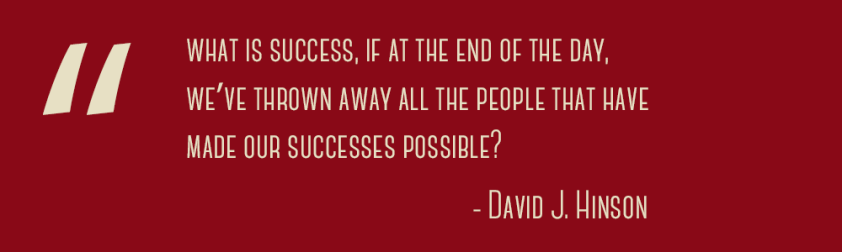
For, what is success, if at the end of the day, we’ve thrown away all the people that have made our successes possible?

Go, and be you.

Audio

Strategy and Tactics

Strategy

Most of us approach our jobs in a very task-oriented fashion. We begin the day, with a list of “to dos” to be performed, and laying out some plan of attack to get our work done.

Completing these atomic elements of work is largely how our performance is judged. Anything that gets in the way of this is a distraction.

For the most part, we nominally consider these tasks “our job”; but, they are actually only the tactical means by which we do our job, and should be part of a larger strategy, dictating why we do the things we do.

When our strategies aren’t in alignment with the tactics we use to carry out that strategy, we’re doing tremendous harm. Maybe we’re touting a strategy of strong customer service, but purposefully implementing bait-and-switch tactics, or understaffing customer call in lines. Or, we espouse a strategy of being a low-cost leader, but implement a high-cost model of acquisition of labor or services, that makes this premise a fool’s errand.

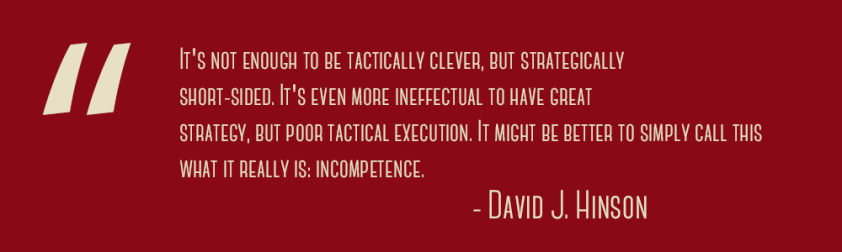
It’s not enough to be tactically clever, but strategically short-sided. It’s even more ineffectual to have great strategy, but poor tactical execution. It might be better to simply call this what it really is: incompetence.

Great companies have strong processes in place, for developing and communicating strategy, throughout their entire organization; and, they equip their people with the appropriate tools and training, in order to develop and execute the tactics necessary to actualize their strategic mission.

When all the elements of great strategy and tactics align, you have companies like Amazon and Southwest dominating their respective spaces. I really don’t need to name those companies that fail this test; you already know, and avoid, them.

To truly master your job, you have to know more than how to perform the tactical duties you think are your job. By understanding the strategy behind what you do, you can performs with 100% confidence and authority.

And help make where you work, great.

Go, and be you.